
Blog home
PRODUCT
OCT 16, 2026
Building Staking 2.0: A New Foundation for Gemini Staking


TL;DR:
-
Staking 2.0 was designed to meet customer demand for more staking assets while keeping reliability at the center of our mission. Hyperliquid became Gemini’s fourth supported asset last month, attracting more than $16 million in AUM.
-
The new platform gives customers a consistent way to stake, unstake, and earn rewards, while handling each blockchain’s specific operations behind the scenes. Retryable workflows and near-real-time checks help it recover from interruptions and surface differences early.
-
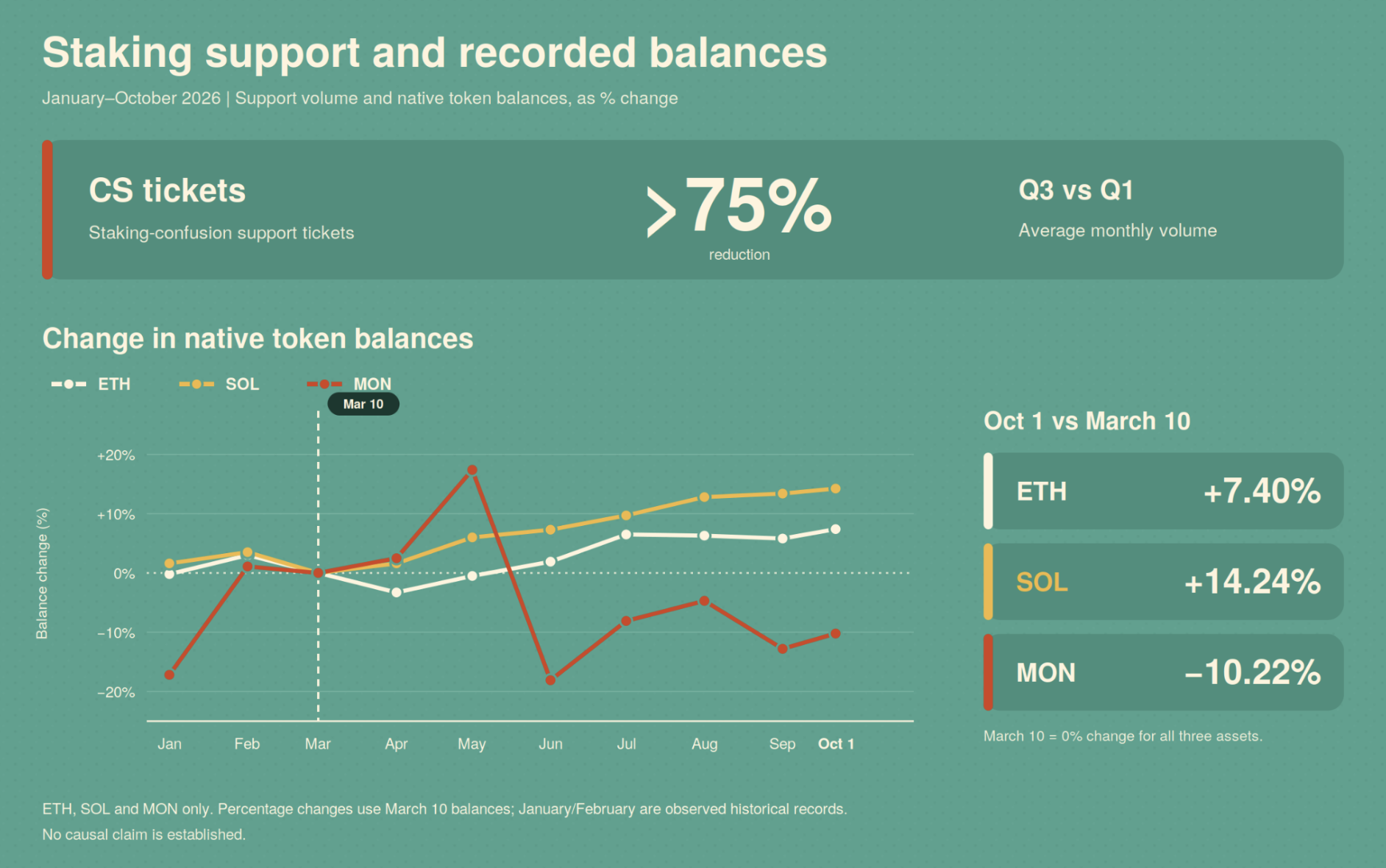
Since Staking 2.0 launched, staking activity has continued to grow while system-related support tickets have declined. AI workflows helped accelerate the rebuild, with engineers overseeing design and critical decisions.
...
Welcome to Staking 2.0.
We rebuilt our staking platform from scratch, going live last month and launching Hyperliquid staking shortly thereafter. The early results are promising.
Since launch, customers have staked more than $16 million in Hyperliquid, showing what can happen when you put consistency and reliability at the center of the system.
Staking may look like a single action in the app, but it coordinates customer balances with network-specific blockchain operations. We built our system to handle both securely and give customers a clear view of their funds and rewards.
Three aspirational goals guided the rebuild:
Keep the staking product reliable in a distributed system: Chain operations and internal services can fail, restart, or complete only part of a workflow. Each step must be safe to retry and recover without creating unintended side effects.
Separated by responsibility: Hyperdrive submits and tracks staking actions on the blockchain, while separate systems collect and distribute rewards. Keeping these responsibilities separate lets us improve and scale each part independently.
Combining AI workflows with human oversight: Agentic AI workflows helped us accelerate the rewrite and make room for more staking assets and better yield-distribution logic. Engineers kept design review and critical decisions in human hands.
Beyond the technical goals, the material impact is apparent. As a result of the update, customer support tickets for issues in the system have declined while the average monthly staking volume has surged.
Top Level Architecture
Accounting follows the chain
The first version of staking processed requests through a first-in, first-out queue. In the new model, we link ledger movements to the on-chain lifecycle they support. That makes it clear which network action a balance change represents and gives us a more direct way to reason about pending work.
Reconciliation catches differences sooner
We added automated, near-real-time reconciliation to compare our staking records with assets observed on-chain and the obligations recorded for customers. That independent check helps surface differences closer to when they arise, while they are easier to investigate. Reconciliation checks operate at both the address and account level, comparing on-chain balances with the obligations recorded for customers.
The checks account for active stake, rewards, and funds moving through staking and unstaking, rather than treating every temporary difference as an error.
Differences are recorded with supporting detail to help teams investigate and distinguish processing delays from accounting discrepancies.
A shared lifecycle for different networks
Staking networks do not use the same steps. One may require delegating stake, another may require preparing a validator, depositing through a contract, and waiting for activation. Staking 2.0 keeps the shared business flow in one place, while network-specific logic defines the operations for that chain and how we know they are complete. That lets us reason about deposits and withdrawals consistently without pretending every blockchain works the same way.
A custom workflow system for staking
Staking 2.0 uses a custom-built workflow system for staking lifecycles. A general-purpose durable workflow system supports the same pattern: Identify which step of the complex execution we are in, resume after interruptions, and make steps safe to retry. Network-specific handlers still define each chain's operations and completion rules.
Building a Seamless Customer Experience
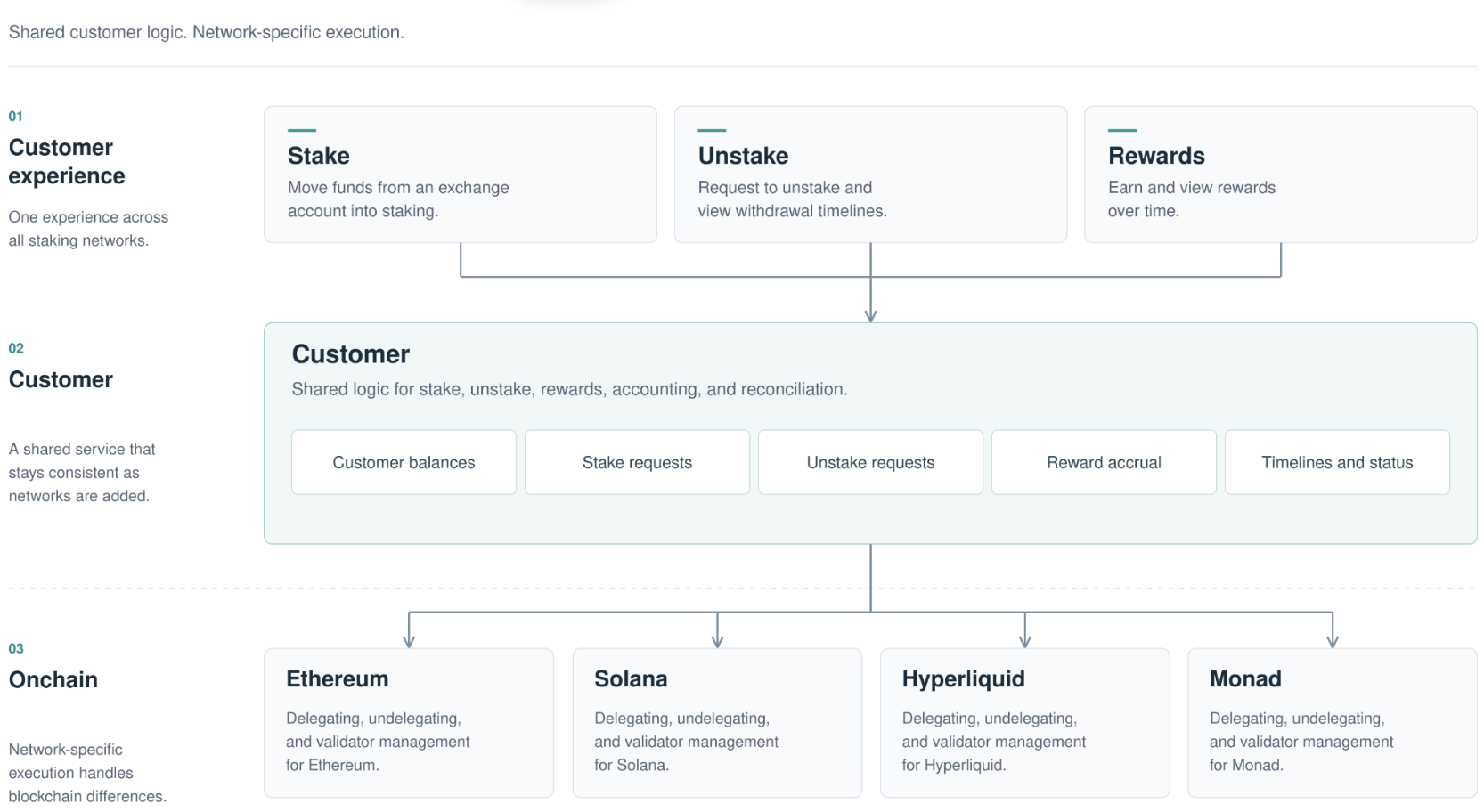
As we added more staking networks, we realized that while the underlying blockchains can be very different, the experience we provide to customers must be largely the same. Customers want to stake funds, unstake them, earn rewards, and understand the status of each action.
That insight shaped the customer side of Staking 2.0. Instead of building a separate customer flow for every network, we created a small, shared customer layer that models these common experiences once. The customer layer tracks stake and unstake requests, balances, rewards, and lifecycle status, while network-specific behavior stays behind that boundary. This allows the customer experience to remain largely unchanged as we add new staking assets.
The separation gives us a clean contract between the two sides of the system: Staking 2.0 Customer Architecture tracks what the customer wants and what we owe them, while Staking 2.0 Onchain handles how those funds are actually staked or unstaked on-chain.
The result is that adding a network like Hyperliquid does not require us to reinvent staking from the customer’s perspective. We can focus our engineering effort on the parts that are genuinely different between networks while reusing the same stake, unstake, rewards, accounting, and reconciliation infrastructure. This matches the broader Staking 2.0 design, which separates customer-facing staking flows from network-specific on-chain execution.
Try Staking 2.0 Today
The crypto market can be volatile, but staking assets offers customers a viable option to earn yield in almost any market. We built Staking 2.0 to provide the most seamless, reliable staking experience available.
RELATED ARTICLES

MARKETS
OCT 15, 2026
Gemini Markets: Inflation Weighs Down Crypto

MARKETS
OCT 08, 2026
Gemini Markets: Winklevoss Brothers Propose ZEC ETF
INSTITUTIONAL
OCT 07, 2026